
Find a Specific Course
-
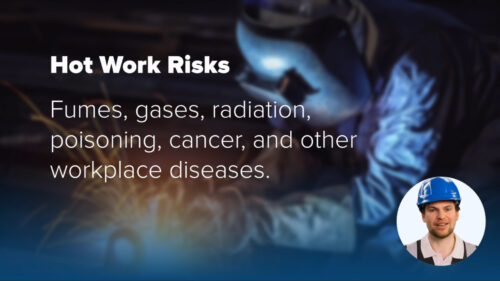
 This course covers the hazards of hot work, requirements for performing hot work, equipment and precautions to ensure the safety of hot work employees, and safety practices for arc welding and cutting and oxygen-fuel gas cutting and welding.
 -
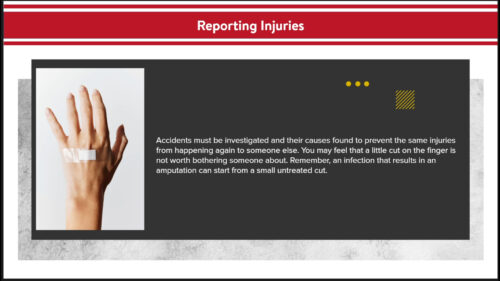
 This course covers the purpose and benefits of incident investigations and investigation methods, as well as common practices for information gathering and documentation, and tools for determining root cause and implementing corrective actions.
 -

 Poor ergonomics can cause pain and injury. This course covers the purpose of ergonomics, common ergonomic problems and their signs and symptoms, and how changes in habits and workspace arrangement can reduce ergo related problems.
 -
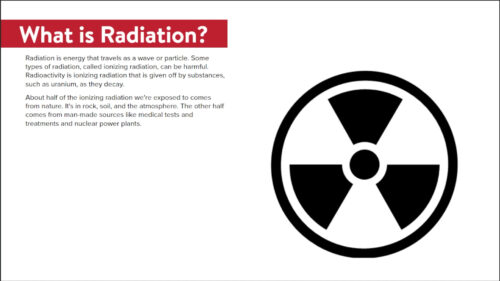
 Exposure to radiation in laboratories must be monitored and mitigated with appropriate safety precautions, because there is a risk for radiation poisoning. Although, proper Personal Protective Equipment (PPE) and knowledge of appropriate safety measures, laboratory environments can limit the likelihood of exposure for students and staff.
 -
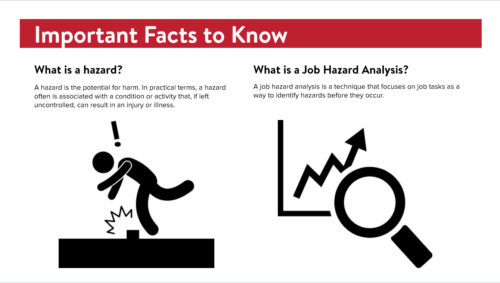
 This course is meant to teach learners how to identify potential hazards in the workplace using various hazard identification tools, with the goal of preventing incidents from occurring.
 -
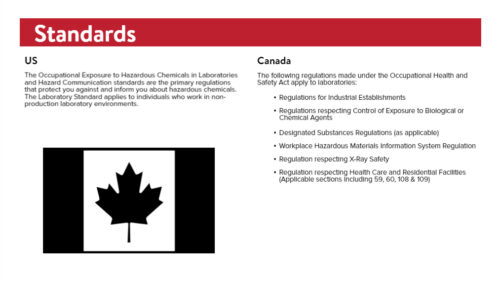
 In non-production laboratories, chemicals pose physical health hazards to workers, which is why they are the number one concern for laboratory employees. These employees will likely be exposed to compounds of certain volatile chemicals.
 -

 Even a little lead poisoning can cause serious health problems, and at very high levels, it can be fatal. Almost 95% of elevated blood lead levels among adults are work-related. Upon completion, you will recall hazards and health effects of lead exposure, ways to determine if there is lead in your workplace, and how to control lead exposure.
 -
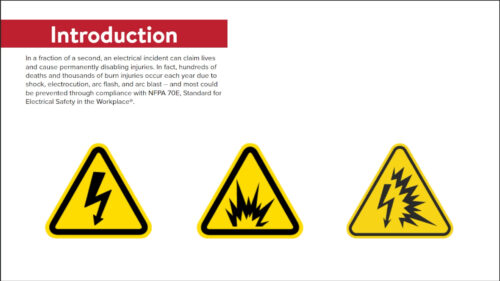
 This course covers electrical regulations, arc flash/arc blast hazards, arc flash risk analysis, flash protection and approach boundaries, PPE and levels of protective clothing, and safe work practices to protect workers around live and exposed parts.
 -
 The term “ergonomics” refers to making the workplace conducive to the comfort and productivity of the employee.
 -

 Wearing PPE is sometimes the only control for specific hazards. The focus of this course is to help employees identify types of PPE and the hazards they protect against, explain characteristics of PPE and worker and employer PPE responsibilities.
 -

 Harassment in the workplace can come in many forms: it can be sexual, physical, or psychological. Often, the terms bullying, abuse, and manipulation will be tied to harassment.
 -
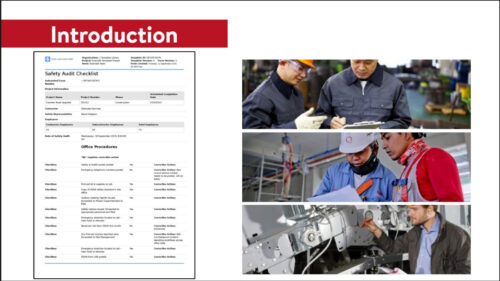
 While not all industries require safety audits to be conducted in the workplace, having regular safety audits performed can help you determine how effective your safety programs are. This course will cover the basics of a safety audit.
 -
 This course on safety awareness will cover the duties of a supervisor, employer and worker and why safety is such an important part of our day. It covers common workplace hazards and how to protect yourself.
 -

 It's reported that scaffolding accidents lead to an estimated 9,000 injuries and 79 fatalities every year.
 -
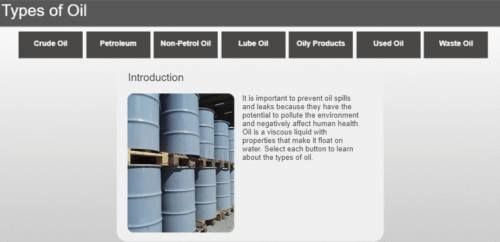
 According to the Environmental Protection Agency (EPA), many of the 14,000 oil spills reported each year are caused by industry activities resulting from storage tank rupturing, pipeline leaks, and oil transport accidents.
 -

 This course will identify the hazards that arise from failing to maintain workspace organization. Good housekeeping implies that a workplace is kept in an organized, uncluttered, and hazard-free condition. While this is a relatively simple concept, the benefits that can be realized from good housekeeping practices are far reaching and affect not only workers' safety but also their health and productivity.
 -

 What makes an effective team? How does one team succeed where others have failed? In this course, you'll learn how team dynamics affect the way we interact with each other, and ways leaders and team members can make the most out of their team experience.
 -

 The purpose of the NFPA standard 70E is to provide a standard for safety-related work practices for the construction, maintenance, operation and demolition of electrical systems in the workplace. This Overview covers awareness-level information for workers who have jobs or assignments that bring them into contact with electrical hazards, such as arc flash and electric shock. Completing this lesson does not designate an employee as an electrically-qualified worker
 -
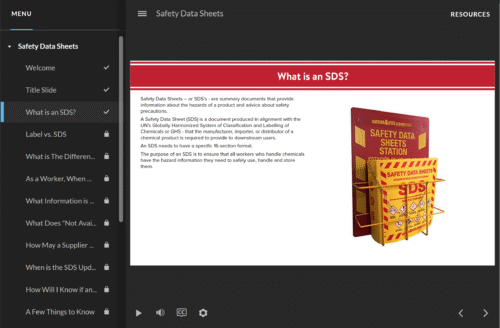
 Safety Data Sheets – or SDS’s - are summary documents that provide information about the hazards of a product and advice about safety precautions. This course covers what an SDS is, when an SDS should be used, what information is found on the SDS and more.
 -
 In this course you will learn an easy-to-understand coaching model, effective methods for giving feedback and constructive criticism, how to increase trust with the members of your team, and how to achieve ongoing, long-term development through mentoring.
 -

 This Critical Thinking and Problem Solving course covers step-by-step, logical thinking approaches as well as out-of-the-box approaches for times when traditional methods just aren’t working. Try a new strategy or two, and bam! You’re back in the game!
 -

 In this course we’ll look at ways you can improve your customer service, whether you work with internal or external customers. We’ll discuss strategies for identifying customer needs, going the extra mile, following up and addressing complaints.
 -

 Whether you need ideas for creating “way-cool” agendas, or how to respond to conflict during the meeting, you're covered. We’ll show you things like how to arrange the room, best times to hold the meeting, and how to break the ice with your attendees.
 -

 Are you emotionally intelligent? We're talking about how you manage your behavior, navigate social situations, and make personal decisions to achieve positive results. This course provides tools, techniques, and tips to be more emotionally intelligent!
 -
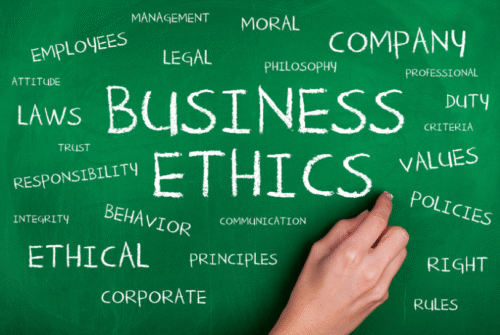
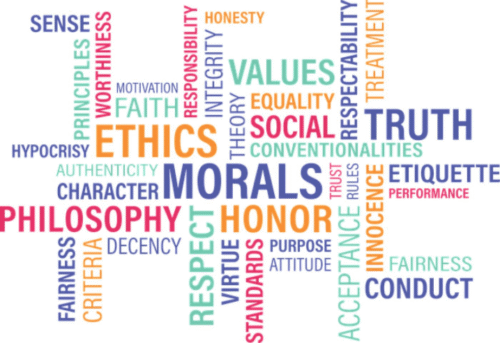 The purpose of an Ethics Program is to reinforce standards of honesty and integrity. This can be done by training employees on ethical standards (honesty, record keeping, conflicts of interest) and how to comply with and report ethical violations.
 -

 This course explains key differences among the generations present in today's workforce, and gives you tips on intergenerational communication. Whether you’re a Traditionalist, Baby Boomer, Gen Xer, or Millennial, a little understanding goes a long way.
 -

 Do you have clear and measurable goals for yourself? Have you written them down? If not, you're not alone. In this course, you'll learn key techniques for setting goals, making plans to achieve those goals, and leading yourself to success.
 -

 This course provides a high-level overview of HIPAA regulations and provides specific best practices for complying with the law and protecting the personal health information you are working with. We’ll also share some general cybersecurity-related tips.
 -

 By improving your initial hiring skills, you can help avoid costly mistakes, and increase company success overall. This course discusses proven ways to find and retain the best candidates, from determining job requirements through on-boarding new hires.
 -

 In this course, you will learn effective strategies for dealing with one of the most common things we avoid: difficult conservations. Whether it's about performance evaluations, request denials, or termination, this course will give you confidence in successfully discussing sensitive topics.
 -
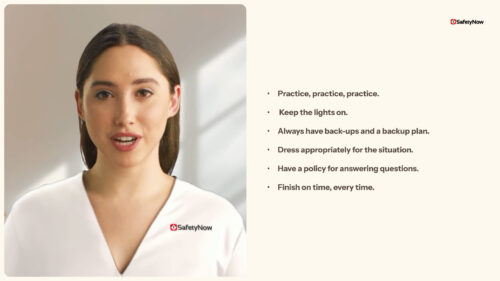
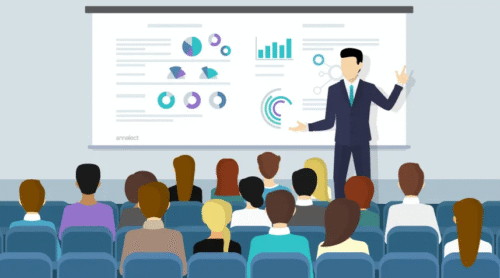 This course will help you improve your presentation skills, including customizing your message for your audience, creating an outline, writing and revising, using visual aids, and delivering your presentation with power.
 -

 This training will help you learn managerial skills needed to create work efficiencies, set appropriate goals and expectations for yourself and your team, delegate responsibilities, manage your time, and provide appropriate feedback.
 -

 Someone calls you a jerk to your face. What do you do about it? Everybody feels frustrated, angry, or even annoyed by another person sometimes. But, there’s a tried and true process you can follow to smooth the prickliest predicament between co-workers.
 -

 This course will help you understand diversity and how you can help create a workplace that values and respects differences. You will learn to identify stereotypes and biases, encourage diversity, and take action to prevent and discourage discrimination.
 -

 The purpose of this course is to recognize how practicing good posture while improving your work area conditions and working ergonomically will protect and strengthen your back. Learn how to identify how a healthy lifestyle, and improving your strength and flexibility, con protect you from work-related injuries.
 -

 Accidents and injuries have both a human and a business cost, so it is advantageous for employees to practice safe behaviors and mitigate unsafe behaviors in the workplace. This lesson introduces behavior-based safety concepts to employees and creates awareness around what influences employees to change unsafe behaviors before an accident or injury happens.
Thousands of Courses Conveniently Packaged
Sure you can move forward a la carte and buy individual courses, but our experts have built bundled packages to meet your industry specific needs.

ADDITIONAL PACKAGES
Bear Essentials $39.95
Canadian Heavy Truck Weight & Dimensions $24.95
CMVs – Safe Driving Behavior for Commercial Motor Vehicles $24.15
H2S Awareness Online Training $49.95
Joint Health & Safety Committees & Representative Online $124.95
Managing Safety Self-Awareness $39.95
Safety Orientation 101 $99.95
SPECIALTY/FRENCH: Transport des Marchandises Dangereuses $36.00
Construction, General & New York City
Research shows that 70% of development happens on the job. At SafetyNow we work hard to make sure you have the engaging training to upskill your employees.
Our entire reason for getting up in the morning is to help as many businesses & organizations as we can to empower their employees & make sure they are safe, healthy, & productive.
Our expansive Employee & Manager Library includes training courses to train new employees, existing employees, new managers, experienced managers, and members of the HR & Executive teams.
Courses cover everything from benefits & leave, compensation, discrimination, health & safety, HR management, performance & termination, and employee communication. You can get access to the entire collection of 83 elearning courses for the starting price of $3.85/learner/month including access to our award-winning Learning Management Platform.
List of Courses
- 8 Steps to Effective One-on-Ones
- 8 Steps to Effective Team Meetings
- Coaching Skills: Captain
- Coaching Skills: Contributor
- Coaching Skills: Introduction
- Coaching Skills: Key Player
- Effective Performance Reviews: Effective Performance Reviews for Managers
- Effective Performance Reviews: Handling a Bad Performance Review
- Effective Performance Reviews: Preparing for Your Review
- Effective Performance Reviews: Self Assessments
- Going from Coworker to Boss
- Managing Different Generations
- How to Be an Ally
- Adopting Inclusive Behaviours at Work
- Working With Different Generations: Introduction to the Working Generations
- Working With Different Generations: Working Together Across Generations
- Working With Different Generations: Working With Baby Boomers
- Working With Different Generations: Working With Gen X
- Working With Different Generations: Working With Gen Z
- Working With Different Generations: Working With Millennials
- Anti-Harassment: 01. Anti-Harassment for Everyone
- Anti-Harassment: 02. Anti-Harassment for Managers
- Anti-Harassment: 03. Writing and Communicating an Anti-Harassment Policy
- Anti-Harassment: 04. Investigating Complaints
- Anti-Harassment: 05. History of Sexual Harassment
- Avoiding Discrimination: 5 Keys
- Diversifying Your Leadership Team
- Employee Recognition
- Fix That Bad Attitude
- Managing for Accountability
- Managing for Engagement: Creating Engagement
- Managing for Engagement: Engagement Matters
- Managing Interns
- Managing People Offsite
- Managing the Grapevine
- Managing Time Versus Energy
- Managing Up: The Art of Managing Your Manager
- Microaggressions
- Understanding Harassment: 01. Introduction to Understanding Harassment
- Understanding Harassment: 02. Understanding Offenders
- Understanding Harassment: 03. Understanding Targets
- Understanding Harassment: 04. Bystander Training
- Understanding Harassment: 05. Warning Signs
- Understanding Harassment: 06. Healthy Culture
- Understanding Harassment: 07. Understanding Harassment in Review
- Analyzing Employee Performance: Can-Do, Will-Do: Actions
- Analyzing Employee Performance: Can-Do, Will-Do: Introduction
- Analyzing Employee Performance: Can-Do, Will-Do: Questions and Tips
- Anti-Racism for Leaders: Allyship
- Anti-Racism for Leaders: Creating and Implementing Policy
- Anti-Racism for Leaders: Diversity-Focused Recruitment
- Anti-Racism for Leaders: Evaluating Your Organization
- Anti-Racism for Leaders: Maintaining Momentum for Leaders
- Anti-Racism for Leaders: Mitigating Bias
- Anti-Racism: Calling Out and Calling In
- Anti-Racism: Colorblindness Doesn’t Work
- Anti-Racism: Learning to Listen and Listening to Learn
- Anti-Racism: Maintaining Momentum
- Anti-Racism: The Anti-Racism Continuum
- Ethics for Managers
- Inheriting Underperformers
- Introverts and Extroverts: Introduction to Introverts and Extroverts
- Introverts and Extroverts: Managing Extroverts
- Introverts and Extroverts: Managing Introverts
- Leadership of a Diverse Group
- Mistakes Leaders Make: Six Wrong Ways to Manage
- Motivating Won’t Do’s
- Psychological Safety for Employees
- Psychological Safety for Managers
- Staying Positive
- Successful Delegation
- Tokenism
- Unconscious Bias: 01. What is Unconscious Bias?
- Unconscious Bias: 02. Types of Unconscious Bias
- Unconscious Bias: 03. Overcoming Unconscious Bias
- Working Well with Everyone: 01. What is Diversity?
- Working Well with Everyone: 02. The Diversity Continuum
- Working Well with Everyone: 03. The Mistake of Stereotyping
- Working Well with Everyone: 04. The Power of Inclusion
- Working Well with Everyone: 05. Diversity = Greatness
- Career Change
- Creating a Work Plan
- Isms: Avoiding Items in the Workplace
- Isms: Exploring Isms in the Workplace
- Isms: Overcoming Isms in the Workplace
- Mistakes Leaders Make: Impedership
- Neurodiversity: Misconceptions About Neurodiversity
- Neurodiversity: Working With Neurodiverse People
- Privilege: Privilege Scenarios
- Privilege: Using Your Privilege
- Privilege: What is Privilege?
- Supervising a Pronoid
- You Get What You Manage – The Pygmalion Effect
- Customer Service Basics
- Productivity Through Praise
- Professional Boundaries: Confidentiality
- Professional Boundaries: Conflicts of Interest
- Professional Boundaries: Nepotism and Favoritism
- Professional Boundaries: Office Romances
- Rethinking Brainstorming
- Riding Along with Sales Reps
- Running a Sales Meeting
- S.C.A.M.P.E.R.
- Territory Management: Managing a New Territory
- Privacy Course Module – HIPAA (US)
- Mental Health Awareness and Support in the Workplace
SafetyNow offers all 31 of the Essential full length courses in French.
SafetyNow currently offers over 250 Spanish safety training courses, and is adding over 20 more each month.

ERGO Inc.’s elearning suite is a fully narrated, engaging, and dynamic suite of 5 core office ergonomic modules. Your employees will learn to correctly set themselves up at a computer workstation and how to use proper body mechanics when performing work functions. Becoming more knowledgeable with their workstation and work tasks will allow employees to be more productive, efficient and safe. It has been designed to deliver critical ergonomic and injury prevention information for office staff anywhere, at anytime.
E-learning provides:
- Animated graphics, audio narration, motion and a flexible format
- Available 24/7 self-paced learning
ERGO Inc.’s Office Ergonomic E-learning modules include:
- Desktop and laptop ergonomic set up and stretching for computer users
- Proper selection of an office chair & 7 steps to properly adjust an office chair
- ERGO Tips for mousing, laptop use, keying and safe handling
- The ergonomics of sit/stand workstations
- How to implement the RIGHT kind of stretching and wellness procedures for ergonomic health
eLearning Administrative Features
You can buy a single module, or all 5 as a suite.
ERGO Inc.’s E-learning solutions can be delivered through SafetyNow or your own LMS. Volume pricing options are available. All courses are guaranteed to work on any LMS and any device.
Download the 2021/2022 ERGO Consulting Services Brochure
Download a Laptop Ergonomics Toolkit Card
Download a Mental Health & Ergonomics Toolkit Card
Utah Food Handlers Training $35.34
ANSI-Accredited Food Handler Training $11.10
Ohio Person-in-Charge Certification in Food Protection $17.99
Florida Food Safety First $13.89
California Food Handler – San Diego County Specific Course $13.89
Texas Food Manager Certification $48.61
Ohio Manager Certification in Food Protection $118.05
Food Safety Manager Principles Training $118.05
ANSI Food Manager Certification Exam with Online Proctor $89.25
Washington D.C. On-Premises Alcohol Awareness Training $34.72
Vermont Alcohol Server Awareness Program (ASAP) $34.72
Washington D.C. Off-Premises Alcohol Awareness Training $34.72
South Carolina Alcohol Seller-Server Training (On-Premises) $20.84
Indiana Alcohol Server Training (On-Premises) $27.76
Indiana Alcohol Server Training (Off-Premises) $27.76
Wyoming Alcohol Seller-Server Training $34.72
Vermont Alcohol Server Awareness Program (ASAP) Off-Premises $34.72
Illinois BASSET Training $20.82
Tobacco Seller Training $13.81
Virginia Alcohol Seller-Server Training $18.05
South Carolina Alcohol Seller-Server Training (Off-Premises) $20.84
North Carolina Responsible Alcohol Seller-Server Training $20.82
Maine Alcohol Seller-Server Training (On-Premises) $13.87
Alcohol Seller-Server Training (On-Premises) $10.41
Alcohol Seller-Server Training (Off-Premises) $10.41
Tennessee Responsible Wine Vendor $20.84
Oregon Alcohol Server Education $20.84
Tennessee Responsible Beer Vendor $16.66
Michigan Alcohol Seller-Server Training $27.76
Oklahoma Alcohol Seller-Server Training $15.20
TABC Certification Training – Alcohol Seller-Server $15.34
Arizona Title 4 Management Training (Off-Premises) $48.61
Arizona Title 4 Management Training (On-Premises) $48.61
Arizona Title 4 Basic Training (Off-Premises) $22.15
Arizona Title 4 Basic Training (On-Premises) $29.16
Utah E.A.S.Y Off-Premises Alcohol Sales Training $23.61
Bowling Green Kentucky Alcohol Seller-Server Training $34.72
Lexington-Fayette Kentucky Alcohol Seller-Server Training $34.72
New York ATAP Certification (Off-Premises) $27.76
New York ATAP Certification (On-Premises) $27.76
Utah On-Premise Alcohol Seller-Server Training $34.16
Wisconsin Responsible Beverage Server Training $20.76
California Responsible Beverage Server Training (RBS) $64.14
TABC SELLER SERVER TRAINING $64.14
