
Find a Specific Course
-
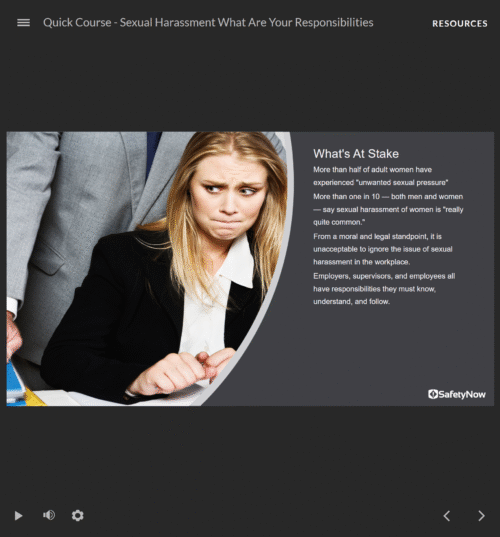
 This quick course covers the important role supervisors play when it comes to the issue of sexual harassment in the workplace. It covers supervisor responsibilities and steps to take if approached with a complaint and employee responsibilities when it comes to sexual harassment responsibilities.
 -
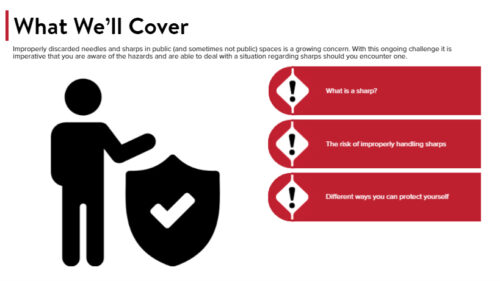
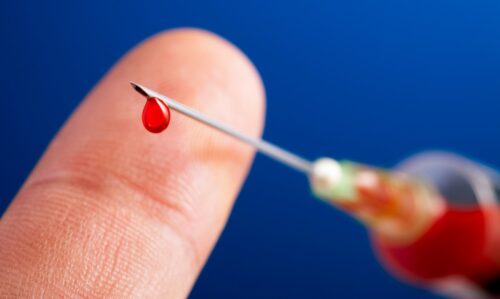 This course will cover sharps safety including what a sharp is, the risk of handling sharps, ways to protect yourself and what to do if you've been pricked or cut by a sharp.
 -
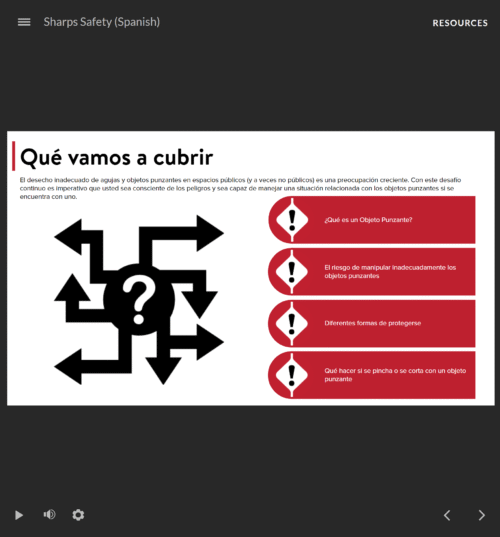 This course will cover sharps safety including what a sharp is, the risk of handling sharps, ways to protect yourself and what to do if you've been pricked or cut by a sharp.
 -
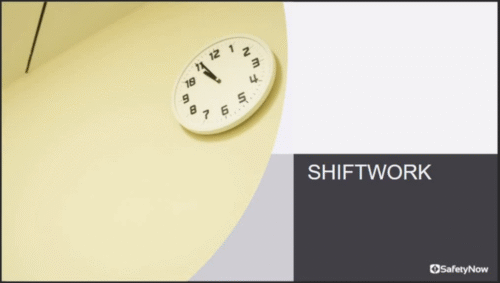
 For many people, their workday either starts in the afternoon and ends late at night, or begins around midnight and ends in the early morning. This quick course covers awareness for shiftwork workers because safety is just as critical as it is with the day crew, but the conditions and hazards may be different.
 -
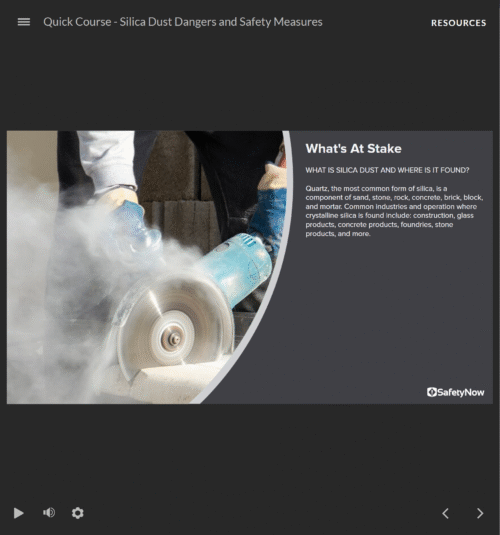
 This quick course covers basic information on silica dust and what the dangers are where this can be found, the main routes of exposure and how to protect yourself from the hazards.
 -
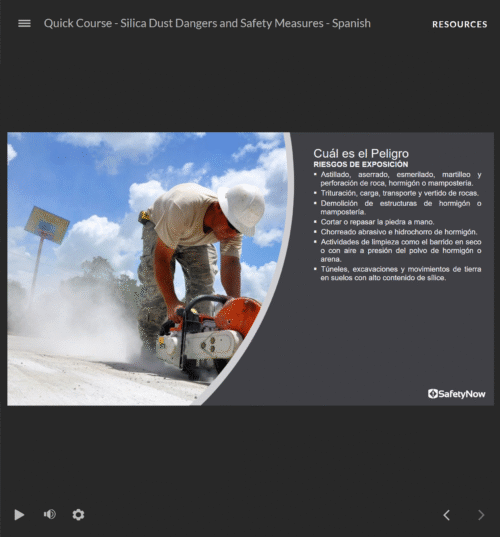
 This quick course covers basic information on silica dust and what the dangers are where this can be found, the main routes of exposure and how to protect yourself from the hazards. (Spanish Version)
 -

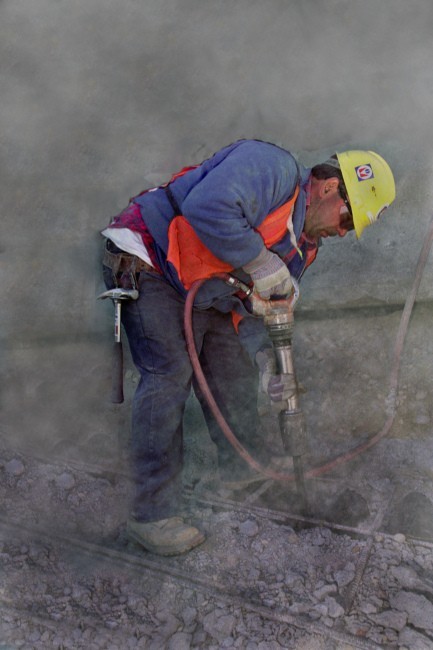 The Occupational Safety and Health Administration (OSHA) has issued a final rule to curb lung cancer, silicosis, chronic obstructive pulmonary disease and kidney disease in America's workers by limiting their exposure to respirable crystalline silica. The rule is comprised of two standards, one for Construction and one for General Industry and Maritime. This lesson is designed to improve the safety of workers in environments where silica exposure hazards exist by increasing employee awareness of this hazard and by demonstrating how the hazard can be recognized and addressed in the workplace.
 -

 This lesson is designed as an intro/refresher to our Silica Hazards course in order to improve the safety of workers in environments where silica exposure hazards exist by increasing employee awareness of this hazard and by demonstrating how the hazard can be recognized and addressed in the workplace.
 -
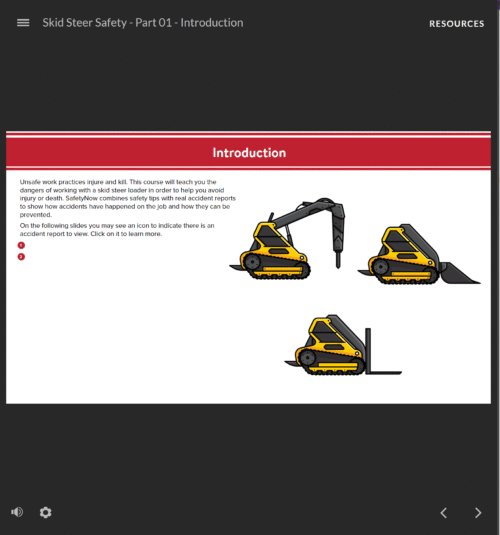
 Part one of this four-part series will introduce you the skid steer including the dangers of working with a skid steer loader in order to help you avoid injury or death.
 -

 Part two of this four-part series will cover safe operation of a skid steer including inspection, start up and shut down and how to avoid dangerous crushing and rollovers.
 -
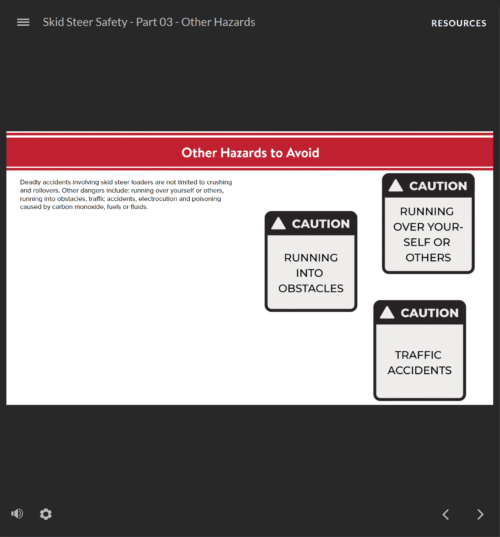
 Part three of this four-part series will cover other hazards of a skid steer including load handling, moving pipe, hazardous conditions, pedestrian safety and more.
 -
 The final part of this four-part series will cover the importance of communication when operating and working around a skid steer including signals and signs.
 -
 Skid-steers can be dangerous due to their short wheelbase and quick turning ability, as well as having a center of gravity that can easily become off balance causing them to tip. The view entirely around the machine can easily be limited. This requires operators to take special note of objects or people that may not always be in the line of sight when operating. We often take for granted that people understand these considerations, but what is obvious to some, may not be so to others and often overlooked. This four-part series will cover the basics of skid steer safety including start-up and shut-down, other hazards and communication.
 -
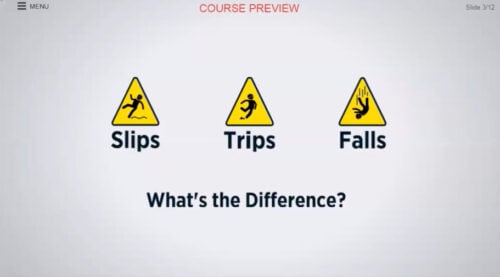
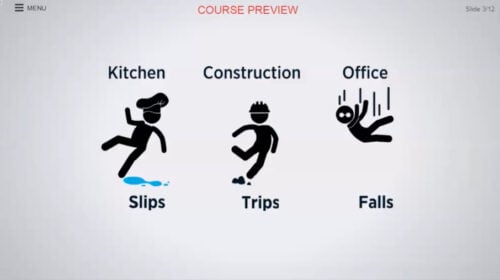 Recent statistics from the Congressional Accountability Office of Compliance indicate that employee falls are private industry’s third leading cause of workplace fatalities. Around 600 workers die from a fatal slip, trip, or fall, each year.
 -
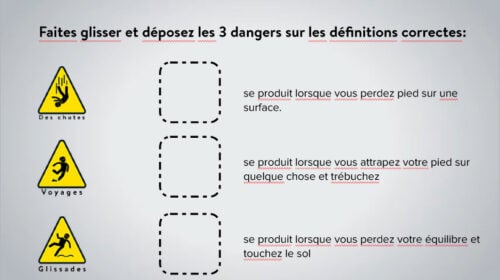
 Slips, trips & falls are the 2nd leading cause of workplace deaths. They are also the leading cause of workplace accidents with over 200,000 reported every year. This course will cover what safety laws say about slips, trips & falls, what hazards to look out for and how you can avoid slips, trips and falls when you work. (French Version)
 -
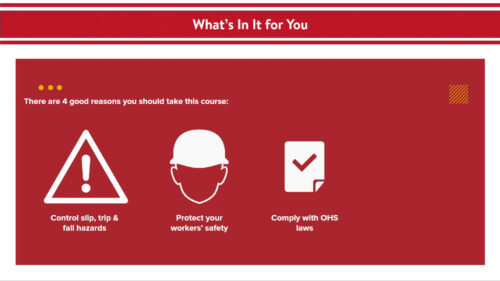
 Developed for managers and supervisors, this course will help you understand and explain the differences between slips, trips and falls, identify and assess the hazards that cause each one and select appropriate controls to manage those hazards, including engineering controls, administrative and work controls and fall protection and other personal protective equipment (or PPE).
 -
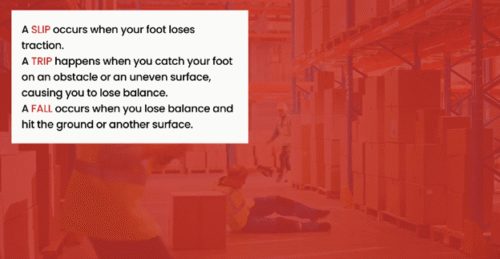
 To prevent slips, trips, and falls, we can take some simple steps, such as.
 -
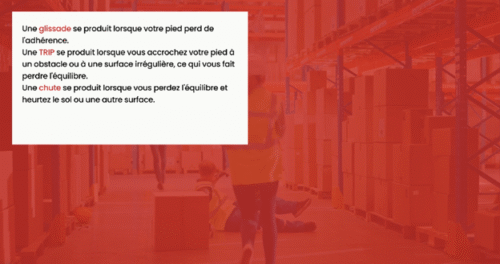
 Safety isn’t just important in high-risk fields like construction or manufacturing. Office safety can have a profound impact on employee health and well-being, just like in any other industry. A safe office environment benefits everyone, creating a positive and productive workplace for all. (French Version)
 -
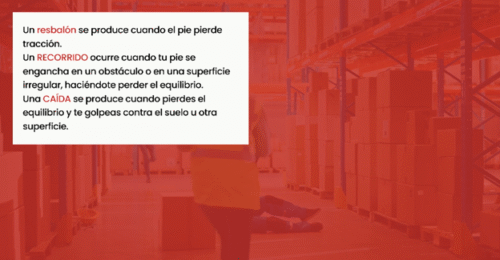
 To prevent slips, trips, and falls, we can take some simple steps, such as. (Spanish Version)
 -
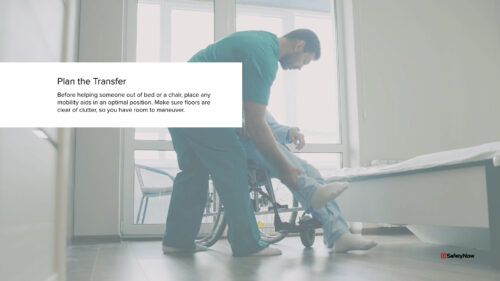
 This short course will explore common risk factors, share some real-life stories, and discuss practical ways to stay steady on your feet—no matter what your workday brings.
 -

 Recent statistics from the Congressional Accountability Office of Compliance indicate that employee falls are private industry’s third leading cause of workplace fatalities. Around 600 workers die from a fatal slip, trip, or fall, each year. This overview of slips, trips, and falls helps reinforce good behaviors for workers on how and where to avoid areas where these hazards can reside.
 -
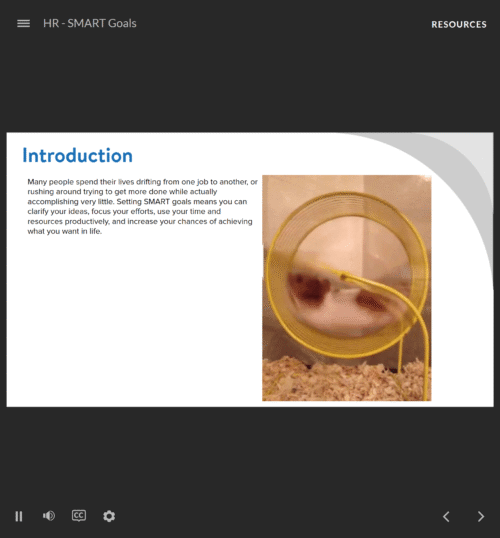
 SMART Goals make it easier to achieve your goals when you have absolute clarity of what your goal is – SMART Goals give you that clarity. This course goes over what SMART goals are, how to use them and avoid goal setting mistakes.
 -
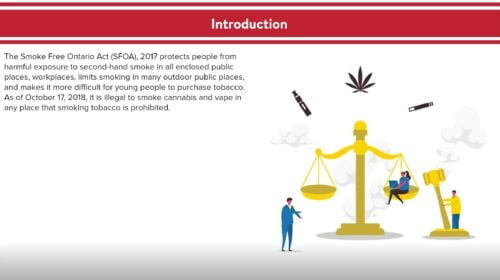
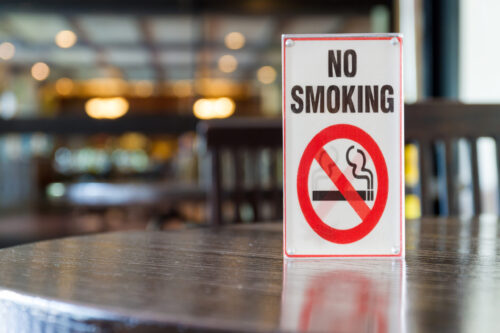 This course covers the basics about the Smoke Free Act in Ontario, and includes regulations on where smoking is prohibited and what is included under the Smoke Free Act.
 -
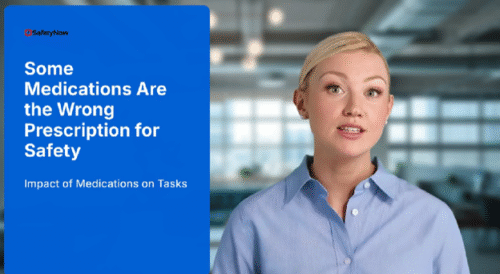 It’s important to be aware of the possible dangers of using prescription drugs and over-the-counter remedies prior to or during work shifts. Be sure to follow all directions and precautions carefully. Talk to your supervisor if you have doubts about your ability to work safely when you are taking a medication.
Thousands of Courses Conveniently Packaged
Sure you can move forward a la carte and buy individual courses, but our experts have built bundled packages to meet your industry specific needs.

ADDITIONAL PACKAGES
Bear Essentials $39.95
Canadian Heavy Truck Weight & Dimensions $24.95
CMVs – Safe Driving Behavior for Commercial Motor Vehicles $24.15
H2S Awareness Online Training $49.95
Joint Health & Safety Committees & Representative Online $124.95
Managing Safety Self-Awareness $39.95
Safety Orientation 101 $99.95
SPECIALTY/FRENCH: Transport des Marchandises Dangereuses $36.00
Construction, General & New York City
Research shows that 70% of development happens on the job. At SafetyNow we work hard to make sure you have the engaging training to upskill your employees.
Our entire reason for getting up in the morning is to help as many businesses & organizations as we can to empower their employees & make sure they are safe, healthy, & productive.
Our expansive Employee & Manager Library includes training courses to train new employees, existing employees, new managers, experienced managers, and members of the HR & Executive teams.
Courses cover everything from benefits & leave, compensation, discrimination, health & safety, HR management, performance & termination, and employee communication. You can get access to the entire collection of 83 elearning courses for the starting price of $3.85/learner/month including access to our award-winning Learning Management Platform.
List of Courses
- 8 Steps to Effective One-on-Ones
- 8 Steps to Effective Team Meetings
- Coaching Skills: Captain
- Coaching Skills: Contributor
- Coaching Skills: Introduction
- Coaching Skills: Key Player
- Effective Performance Reviews: Effective Performance Reviews for Managers
- Effective Performance Reviews: Handling a Bad Performance Review
- Effective Performance Reviews: Preparing for Your Review
- Effective Performance Reviews: Self Assessments
- Going from Coworker to Boss
- Managing Different Generations
- How to Be an Ally
- Adopting Inclusive Behaviours at Work
- Working With Different Generations: Introduction to the Working Generations
- Working With Different Generations: Working Together Across Generations
- Working With Different Generations: Working With Baby Boomers
- Working With Different Generations: Working With Gen X
- Working With Different Generations: Working With Gen Z
- Working With Different Generations: Working With Millennials
- Anti-Harassment: 01. Anti-Harassment for Everyone
- Anti-Harassment: 02. Anti-Harassment for Managers
- Anti-Harassment: 03. Writing and Communicating an Anti-Harassment Policy
- Anti-Harassment: 04. Investigating Complaints
- Anti-Harassment: 05. History of Sexual Harassment
- Avoiding Discrimination: 5 Keys
- Diversifying Your Leadership Team
- Employee Recognition
- Fix That Bad Attitude
- Managing for Accountability
- Managing for Engagement: Creating Engagement
- Managing for Engagement: Engagement Matters
- Managing Interns
- Managing People Offsite
- Managing the Grapevine
- Managing Time Versus Energy
- Managing Up: The Art of Managing Your Manager
- Microaggressions
- Understanding Harassment: 01. Introduction to Understanding Harassment
- Understanding Harassment: 02. Understanding Offenders
- Understanding Harassment: 03. Understanding Targets
- Understanding Harassment: 04. Bystander Training
- Understanding Harassment: 05. Warning Signs
- Understanding Harassment: 06. Healthy Culture
- Understanding Harassment: 07. Understanding Harassment in Review
- Analyzing Employee Performance: Can-Do, Will-Do: Actions
- Analyzing Employee Performance: Can-Do, Will-Do: Introduction
- Analyzing Employee Performance: Can-Do, Will-Do: Questions and Tips
- Anti-Racism for Leaders: Allyship
- Anti-Racism for Leaders: Creating and Implementing Policy
- Anti-Racism for Leaders: Diversity-Focused Recruitment
- Anti-Racism for Leaders: Evaluating Your Organization
- Anti-Racism for Leaders: Maintaining Momentum for Leaders
- Anti-Racism for Leaders: Mitigating Bias
- Anti-Racism: Calling Out and Calling In
- Anti-Racism: Colorblindness Doesn’t Work
- Anti-Racism: Learning to Listen and Listening to Learn
- Anti-Racism: Maintaining Momentum
- Anti-Racism: The Anti-Racism Continuum
- Ethics for Managers
- Inheriting Underperformers
- Introverts and Extroverts: Introduction to Introverts and Extroverts
- Introverts and Extroverts: Managing Extroverts
- Introverts and Extroverts: Managing Introverts
- Leadership of a Diverse Group
- Mistakes Leaders Make: Six Wrong Ways to Manage
- Motivating Won’t Do’s
- Psychological Safety for Employees
- Psychological Safety for Managers
- Staying Positive
- Successful Delegation
- Tokenism
- Unconscious Bias: 01. What is Unconscious Bias?
- Unconscious Bias: 02. Types of Unconscious Bias
- Unconscious Bias: 03. Overcoming Unconscious Bias
- Working Well with Everyone: 01. What is Diversity?
- Working Well with Everyone: 02. The Diversity Continuum
- Working Well with Everyone: 03. The Mistake of Stereotyping
- Working Well with Everyone: 04. The Power of Inclusion
- Working Well with Everyone: 05. Diversity = Greatness
- Career Change
- Creating a Work Plan
- Isms: Avoiding Items in the Workplace
- Isms: Exploring Isms in the Workplace
- Isms: Overcoming Isms in the Workplace
- Mistakes Leaders Make: Impedership
- Neurodiversity: Misconceptions About Neurodiversity
- Neurodiversity: Working With Neurodiverse People
- Privilege: Privilege Scenarios
- Privilege: Using Your Privilege
- Privilege: What is Privilege?
- Supervising a Pronoid
- You Get What You Manage – The Pygmalion Effect
- Customer Service Basics
- Productivity Through Praise
- Professional Boundaries: Confidentiality
- Professional Boundaries: Conflicts of Interest
- Professional Boundaries: Nepotism and Favoritism
- Professional Boundaries: Office Romances
- Rethinking Brainstorming
- Riding Along with Sales Reps
- Running a Sales Meeting
- S.C.A.M.P.E.R.
- Territory Management: Managing a New Territory
- Privacy Course Module – HIPAA (US)
- Mental Health Awareness and Support in the Workplace
SafetyNow offers all 31 of the Essential full length courses in French.
SafetyNow currently offers over 250 Spanish safety training courses, and is adding over 20 more each month.

ERGO Inc.’s elearning suite is a fully narrated, engaging, and dynamic suite of 5 core office ergonomic modules. Your employees will learn to correctly set themselves up at a computer workstation and how to use proper body mechanics when performing work functions. Becoming more knowledgeable with their workstation and work tasks will allow employees to be more productive, efficient and safe. It has been designed to deliver critical ergonomic and injury prevention information for office staff anywhere, at anytime.
E-learning provides:
- Animated graphics, audio narration, motion and a flexible format
- Available 24/7 self-paced learning
ERGO Inc.’s Office Ergonomic E-learning modules include:
- Desktop and laptop ergonomic set up and stretching for computer users
- Proper selection of an office chair & 7 steps to properly adjust an office chair
- ERGO Tips for mousing, laptop use, keying and safe handling
- The ergonomics of sit/stand workstations
- How to implement the RIGHT kind of stretching and wellness procedures for ergonomic health
eLearning Administrative Features
You can buy a single module, or all 5 as a suite.
ERGO Inc.’s E-learning solutions can be delivered through SafetyNow or your own LMS. Volume pricing options are available. All courses are guaranteed to work on any LMS and any device.
Download the 2021/2022 ERGO Consulting Services Brochure
Download a Laptop Ergonomics Toolkit Card
Download a Mental Health & Ergonomics Toolkit Card
Utah Food Handlers Training $35.34
ANSI-Accredited Food Handler Training $11.10
Ohio Person-in-Charge Certification in Food Protection $17.99
Florida Food Safety First $13.89
California Food Handler – San Diego County Specific Course $13.89
Texas Food Manager Certification $48.61
Ohio Manager Certification in Food Protection $118.05
Food Safety Manager Principles Training $118.05
ANSI Food Manager Certification Exam with Online Proctor $89.25
Washington D.C. On-Premises Alcohol Awareness Training $34.72
Vermont Alcohol Server Awareness Program (ASAP) $34.72
Washington D.C. Off-Premises Alcohol Awareness Training $34.72
South Carolina Alcohol Seller-Server Training (On-Premises) $20.84
Indiana Alcohol Server Training (On-Premises) $27.76
Indiana Alcohol Server Training (Off-Premises) $27.76
Wyoming Alcohol Seller-Server Training $34.72
Vermont Alcohol Server Awareness Program (ASAP) Off-Premises $34.72
Illinois BASSET Training $20.82
Tobacco Seller Training $13.81
Virginia Alcohol Seller-Server Training $18.05
South Carolina Alcohol Seller-Server Training (Off-Premises) $20.84
North Carolina Responsible Alcohol Seller-Server Training $20.82
Maine Alcohol Seller-Server Training (On-Premises) $13.87
Alcohol Seller-Server Training (On-Premises) $10.41
Alcohol Seller-Server Training (Off-Premises) $10.41
Tennessee Responsible Wine Vendor $20.84
Oregon Alcohol Server Education $20.84
Tennessee Responsible Beer Vendor $16.66
Michigan Alcohol Seller-Server Training $27.76
Oklahoma Alcohol Seller-Server Training $15.20
TABC Certification Training – Alcohol Seller-Server $15.34
Arizona Title 4 Management Training (Off-Premises) $48.61
Arizona Title 4 Management Training (On-Premises) $48.61
Arizona Title 4 Basic Training (Off-Premises) $22.15
Arizona Title 4 Basic Training (On-Premises) $29.16
Utah E.A.S.Y Off-Premises Alcohol Sales Training $23.61
Bowling Green Kentucky Alcohol Seller-Server Training $34.72
Lexington-Fayette Kentucky Alcohol Seller-Server Training $34.72
New York ATAP Certification (Off-Premises) $27.76
New York ATAP Certification (On-Premises) $27.76
Utah On-Premise Alcohol Seller-Server Training $34.16
Wisconsin Responsible Beverage Server Training $20.76
California Responsible Beverage Server Training (RBS) $64.14
TABC SELLER SERVER TRAINING $64.14
